All posts by willhirstle

HOW TO PROMOTE COMMUNITY EVENTS – SEVEN WAYS TO REACH YOUR AUDIENCE

Promoting a community events programme is just as important as the planning of the activities themselves, and usually requires as much time and effort.

Here is Clarity’s guide to some promotional methods that we’ve found to work well.

1. Plan a launch event

A good way to get your community activities programme off the ground is with a launch event focused primarily on creating interest in the rest of the programme.

Launch events tend to be of two types. The first is a formal launch with a targeted audience of invited attendees and a structured programme of activities and presentations. The other is less formal and structured, and aimed at making something happen to raise awareness in your target community – a drop-in children’s activity, a taster workshop for adults, people in period costume, a performance, even a flashmob – whatever is relevant and will draw people in. Whichever way you go, create a buzz in local media by getting some coverage, perhaps ask the mayor or other dignitary to come along and do an official launch. Make sure you use all your social media channels to showcase the event by creating something Instagramable.
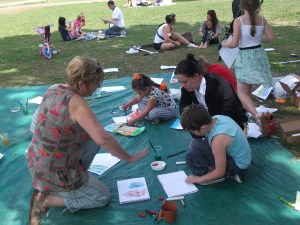
Childrens art community activity
Drop-in children’s art activity in a busy park

Engage with everyone who comes to see what’s going on and tell them about what’s coming up – give them an events listing, a flyer with your website address, a summary of the project, and ask them to sign up to get emails about events coming up (reassuring them that they won’t be spammed!)

2. Start an e-mail list

If you don’t have a mail-out list, START ONE NOW! In our experience, direct e-mail is the most powerful tool for promoting community events.

If you did a launch event hopefully you will have some addresses to start you off. Also include people in your own existing networks – colleagues, volunteers, staff at partner organisations, members of community groups, even friends and family.

Your list will grow as your programme goes along. For events people need to book onto, you should ask for email addresses to send out confirmations and event details. You can then ask to add these to your list (and offer a clear and easy opt out).

During non-bookable or drop-in events, take time to approach participants with a sign-up list and ask if they would like to hear about future events via e-mail.

You should also have a sign-up form on your web site and use social media to make people aware that they can join – post a link to the sign-up form.

3. Produce a printed events programme

At Clarity we use new technology in promoting events but we still find that the good old printed ‘what’s-on?’ booklet is pretty effective. People like to pick them up and keep them for that moment when they are asking themselves ‘what can we do this weekend?’
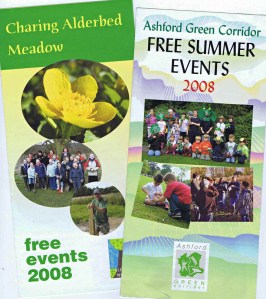
Printed events programmes

Put images featuring people on the cover and if some or all of your activities are free, make that clear. Distribute them to libraries, tourist information centres, community centres and local attractions. Use a small, standard format – DL or A5 – so that they can display them easily in their racks. Ask people in your work and personal networks to put them into places that you might not be able to get to yourself. Ask partner attractions to stock them, and don’t forget to take some along to all your activities once they start!

4. Promote events individually and in a targeted way

In addition to promoting an activity programme as a whole, for example via a printed ‘what’s-on?’, we find event-by-event promotion extremely effective. We recommend doing this in three ways:

Firstly, every single event should be promoted individually via an email sent out to everyone on your list who might be interested. Use the subject line to offer something irresistible to these recipients: ‘Photograph one of Britain’s rarest butterflies’; ‘Explore an ancient historical site through art’. We find sending the email two to three weeks in advance is long enough for small, low cost or free activities but you may need to give more lead-in for large events or pricier paid-for activities.

Depending on how bookings go, you may want to send a follow-up email in the week leading up to the activity. We have found some organisers baulk at this, afraid of over-doing it and annoying people, but as long as the event is relevant to the recipient, you should not get any complaints. To make sure it is relevant, segment your list, using groups in Outlook or the tools in E-mail Marketing Software like MailChimp, according to what recipients are interested in or where  they live.

Secondly, if it’s possible on your website, create an individual event page for every activity, containing full details and a quality ‘featured’ image.

Example website event page
Example website calendar event page

Thirdly, create a separate Facebook event for every activity and individually invite all Facebook friends who you think would be interested. Do this around the time you send out your targeted email (you don’t need to invite people on the email list!) Then keep people updated: post a status if the event is nearly fully booked – ‘Just a few places left!’ – or post a link to the event website page as a reminder if take-up is slow. Boosting posts is a good way to gain momentum in the early stages of a project.
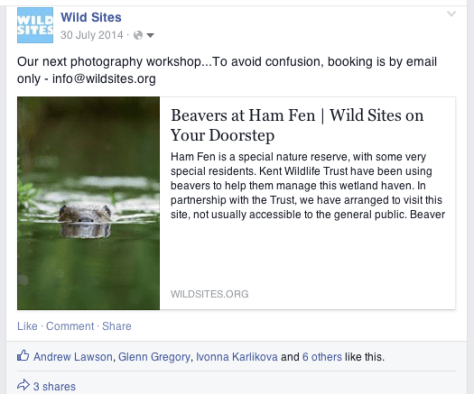
Screen shot 2015-05-15 at 12.57.41
Facebook post linking to a website event page

5. Promote directly to organised groups and online communities

We found organised groups a great way of reaching people with an interest in specific activities. For example, we found lots of participants for wildlife photography events from local camera clubs. Many groups have websites with email addresses or contact forms, and are more than happy to hear from someone offering activities their members might enjoy. There are also directory websites with lists of local community groups and contact details. Think about offering events exclusively for the members of a group – a ready-made audience.

Facebook groups can also be a good way of contacting large numbers of interested people. We have promoted outdoor painting events on local arts-related Facebook groups. Make sure the group allows the promotion of events before you post anything by reading the ‘about’ or ‘description’ section. Also search for relevant pages with lots of likes and approach the admin by messaging them and asking to post a link to your website event page.

6. Produce simple posters and flyers

Don’t forget good old-fashioned posters and flyers! They don’t have to be works of art, just clear and eye-catching, with all the relevant information. Get a designer to set up simple templates in Word or Publisher, then you can just change venues, times and insert one or two relevant images. Web address and social media icons should be prominent. Use QR codes to link to booking pages.
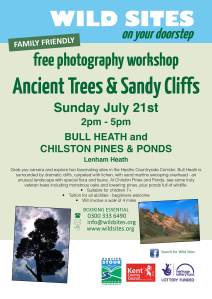
A4 poster
A4 community event poster

Posters are best used at the site where an upcoming activity is going to take place. Put them up at least 10 days before the event but not so far in advance that they become faded or rain-damaged. Don’t overdo it – just put up one at each of a few key entry points – and make sure you arrange for them to be taken down once the event is over. You could try making use of notice boards at visitors centres, libraries, local shops etc. but we’ve had limited success with this. Parish notice boards in small rural communities are probably more likely to get looked at – approach the parish council for permission.

You can try handing out flyers at your event venue a week or two in advance and engage with people about the activity coming up (this may not be worthwhile if it is a quiet site with few visitors). Flyers are great for handing out to people at an event to promote the next activity coming up. Also, ask partner organisations/attractions to have flyers available if they have similar events during your lead-in.

Bulk, ‘scatter-gun’ distribution of posters and flyers in the high street or elsewhere is probably not the best use of your time and could even damage the image of your project. The same can be true of delivering them door to door; the exception to this is if an activity is very focused on residents’ concerns, or changes in a particular neighbourhood (for example, a workshop to consult on designs for a new park) then you can target the households in the relevant area.

7. Give people something to take away

Finally, when an event is over, offer participants a pack to take with them. Contents should include an events programme booklet, a flyer for the next upcoming activity, a feedback form for your monitoring and a pre-paid envelope for its return. Literature specific to the site could also be included. If it was a children’s event, you could add a fun activity sheet or branded items like badges or stationery. Items should be sustainably produced. Before participants head off, have a booking sheet handy for the next activity and offer them the opportunity to sign up early.
Reducing vandalism to interpretation panels – six top tips

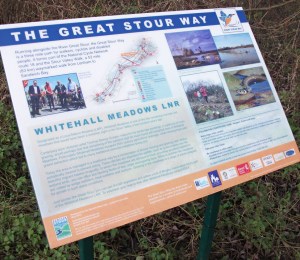
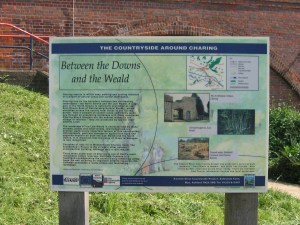
Interpretation panels have a hard life sometimes! Graffitied, scratched, shot at, burnt or stolen for scrap, we all know they are vulnerable to attack, particularly at urban sites. So is there anything you can do to reduce these problems? The right materials are a starting point, but there are other things you can try as well. 

  1. Panel material – robust or replaceable?

The temptation at vandal-prone sites is to go for the most hard-wearing, durable material possible – a thick slab of GRP (glass-reinforced plastic) or robust polycarbonate. This can work but, while they can take a lot of punishment, these materials are not vandal-proof and a single, determined attack could leave you needing a costly replacement board.

I think it’s always worth considering instead the ‘easy replacement option’, where graphics are printed onto Dibond (aluminium composite). This material is much more affordable to produce and replace. You can have multiple copies of the panel printed so if there is an incident of severe damage you just replace the vandalised panel with a new one (all our framed structures can be opened).

dibond layers
Dibond (aluminium composite) is an industry standard signage material made from layers of aluminium with a polyethylene core. It is robust, recyclable and because the aluminium is bonded to the core, deters metal theft.

The Dibond we supply is protected with a clear, matt finish anti-scratch laminate meaning graffiti can usually be cleaned off very easily.

The other advantage is that information can be updated at minimal cost, making Dibond a great option for sites with many repeat visitors where you want to refresh content regularly.

  1. Frame and posts – keep it simple!

The first rule at vandal-prone sites is to avoid timber frames – they are too easily burnt, scored and damaged. Steel is preferable. Although you could see any frame as just something else to get damaged so I often recommend frameless panels like this one at an urban site.

Frameless panel on steel posts

I would usually recommend steel posts at urban sites. If metal theft is an issue, there are alternatives – timber sleepers are very robust, and recycled plastic works well, particularly in wetland sites where steel may rust.

Steel frame, timber sleeper post

  1. Design – avoid blank spaces

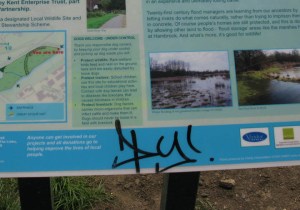
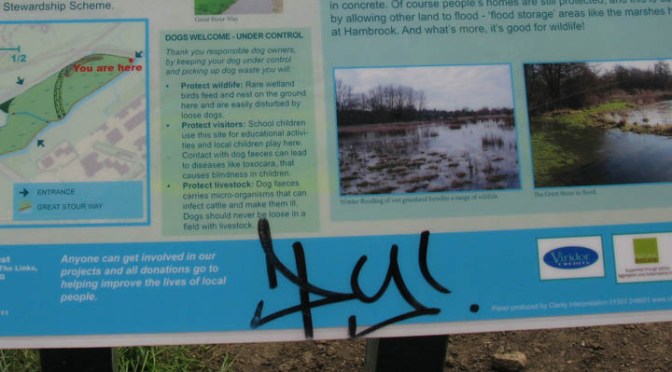
Sometimes I’ve found that the design of the graphics themselves can have an effect on vandalism, particularly graffiti ‘tags’. A tag is essentially a personalised graffiti signature and someone tagging will usually look for a white or pale coloured space so that the tag stands out. Avoiding blank spaces and pale colours in a panel design can deter tagging and other graffiti. And a panel free of graffiti is also less likely to get physically damaged.

graffiti

  1. Location, location, location

It probably sounds like common sense, but you can avoid a lot of potential problems with graffiti and vandalism by careful location of interpretive panels.

Avoid:

–  Areas hidden from public view
–  Areas with an existing vandalism or graffiti problem
–  Benches, shelters, play parks, skate parks and other ‘hang-outs’
–  Quiet areas with few people passing through

Go for:

–  Busy main entrances and thoroughfares (you will want the maximum number of visitors to see the panel anyway)
–  Areas overlooked by houses or roads
–  Areas that wardens/site managers go to regularly

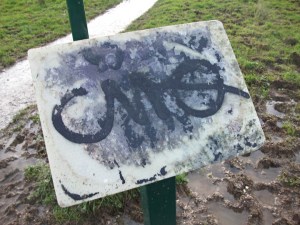
vandalised panel
Panel in out of the way area completely obliterated

  1. Time it right

So you’ve got your brand new panel, with the right materials and design, and have chosen your best, busy location in clear view of visitors. Can the time of year you install the panel really make a difference to whether it gets vandalised? In my experience it can.

I’m not saying that all graffiti and damage is inflicted by school-aged children, but I have found that panels installed during the Easter or summer holidays have sometimes suffered a lot of graffiti or damage very quickly. If you can, delay installing until after the holidays.

  1. Keep up appearances

If there is one single thing that I would recommend site managers and wardens do to safeguard their panels it’s to monitor and maintain them.

It’s essential that you respond quickly to any graffiti – if left it will probably attract more. Even a persistent tagger will usually give up if you are even more persistent with cleaning off their handiwork. You can buy specialist graffiti remover, but most of the time a bit of mentholated spirit on a sponge or rag will work just as well.

It’s good to clean your panels regularly. An eco household cleaner and a damp cloth is all that’s needed in most cases to remove dirt and algae from panels and frames. Keep metal painted and well maintained – this will help to prevent rust as well. The key thing is to keep the whole thing looking cared for – in my experience a poorly maintained panel is much more likely to attract vandals.

Panels at rural stations - they are regularly maintained and still undamaged after 15 years
Panels at rural stations – they are regularly maintained and still undamaged after 15 years

Fingers crossed!

Of course there are no guarantees! Vandalism can be very unpredictable and there is no such thing as a vandal-proof panel. But these tips should improve your panel’s chances of survival in a tough world and hopefully extend the life of what can be an expensive item to replace.

Read about the interpretation panels Clarity supply.

On paper, everything you need

Even in this Internet age, most countryside and heritage organisations still find themselves producing some good old-fashioned printed leaflets, booklets and brochures.

A printed site guide can still be the most cost-effective way of informing visitors about nature reserves, country parks and heritage attractions. Walk guides and trails are often still most easily used in leaflet or booklet form. Physical newsletters or what’s-on programmes still have their place alongside e-mail and Facebook events.

We are experienced graphic designers and bring all our visual and interpretation writing skills to the task of producing printed matter that gets your messages across, and engages people with their environment. Our artists can produce bespoke maps and illustrations to the highest standard. And we only use environmentally-friendly papers.

As well as site interpretation, we also have years of experience of promotional print – brochures, events guides, posters, flyers, pop-ups and display stands, as well as organisational documents like annual reports.

Download samples of our work:

Ashford Green Corridor leaflet (PDF 6.6MB)
Bredhurst Woods leaflet (PDF 3.9MB)
Boxley Warren leaflet (PDF 4MB)
Kent Mammal Group leaflet (inside) (PDF 1MB)

What our clients say

“The leaflet reflects everything that we love about the area so your efforts are really appreciated.”
Lynne Tindle, Secretary, Friends of Boxley Warren
Download leaflet

site leaflet cover - boxley warren
 

“You’ve made a brilliant piece of history for everybody, you’ve recorded all the best memories along with the photos and maps and I’m sure people will be fascinated to see this…That’s the best 20 minutes I’ve spent for a long time!”
Lynette Coleman, Original Toddler’s Cove Group


“Thank you so much! We would gladly recommend you to others. I hope BWAG can work with you again soon.”

Vanessa Jones, Bredhurst Woods Action Group

Download leaflet

Bredhurst Woods leaflet


“Thank you so much for all the work you have done to create the new website – it really looks good and is so easy to navigate.”
Anthony Dance, Canterbury City Council

 
screen-shot-2016-09-13-at-11-27-32
 

“I wanted to contact your company to congratulate you on the fantastic display in Bridgwater…It was beautifully put together and so well presented.”
Yolanda Bentham, Bridgwater resident

bricks that built bridgwater
We developed this branding for heritage interpretation panels in Bridgwater, Somerset

“I wanted to say thank you so much for your assistance with our interpretation panel…I managed to get our mayor and our chairman to unveil it. It was much admired and I often see walkers stopping to read it.”
Jan Holben, Friends of Folkestone Cemetery

 
folkestone cemetary interpretation board


“We have just received the leaflet about the Harrietsham Discovery Trail and I would like to congratulate you on producing such an interesting and well produced piece of work. Though we have lived in Ulcombe for 35 years much of the information in it was new to me. I am hoping to walk the trails with my dog very soon!” 
Elizabeth, local resident